
Case Study: Methodology for Developing Team Member Workstations
The Challenge: Traditional Workstations Create Strain and Waste
 In most manufacturing environments, workstations are traditionally designed around the task rather than the person performing it. Operators in assembly, inspection, testing, packaging, and quality control often spend hours at stations that unintentionally lead to strain, overreaching, poor posture, and unnecessary motion. Over time, these ergonomic shortcomings contribute to operator fatigue, musculoskeletal injuries, and inconsistent production cycle times.
Assessing Operator Needs Through Lean and Ergonomic Evaluation
Novo Lean Solutions set out to design a Team Member Workstation that met the needs of operators on the manufacturing line while enabling true one-piece flow grounded in lean manufacturing principles. The needs of the team member workstation were assessed using the publication “Lean Assessment Tool for Workstation Design of Assembly Lines” by Micael Gonçalves and Konstantinos Salonitis (Dec 2017). Gonçalves et al. proposed a workstation evaluation hierarchy based on the structure of Maslow’s Hierarchy of Needs to categorize the needs a workstation must meet before achieving excellence. These needs are split into four categories: functionality, effectiveness, efficiency, and satisfaction. Only when all four of these needs are fulfilled can excellence be achieved.

Figure 1: Hierarchy of Workstations Needs (Micael Gonçalves and Konstantinos Salonitis)
Understanding the Ergonomic Implications
Novo Lean Solutions Workstations observed assembly processes at Novo Precision and assessed available Workstation options for purchase today. The first portion of the assessments focused on the Physical and Safety Needs of the operators. Operators reported upper-arm, shoulder, and back pain due to repetitive overreach and to workstation heights. It was noted that “operators report occasional upper arm and shoulder pain that come from the continuous overreach outside of the ergonomic Green Zone” and “back pain… caused by non‑ideal workstation heights.”
To document the current state, the Rapid Entire Body Assessment (REBA) ergonomic assessment method was used. Figure 2 shows an operator reaching for parts during the assembly process with a total REBA Score of 7, which is a Risk Level of HIGH.

Figure 2: Operator Demonstration of Assembling Product on Current Workbench
During the assessment, it was observed that available workstation designs lacked integrated material handling, required excessive horizontal surfaces, and forced operators to improvise. Observing the process and the workstation revealed the ingenuity of the operators, such as evidence that they were using the flat sides of their pliers to press components.
In addition to mapping the manufacturing process and material‑handling points, operators were interviewed to share their insights and ideas. For example, the operators noted that they needed a safe place for their personal items during their shifts. They also noted that parts could drop below the current bench, making it difficult to keep the station clean. Giving these experts a voice is a critical part of the development process.
The current state solution highlighted operator ergonomic strain wasted motion (Muda), and inconsistent One‑Piece Flow.
Novo Lean Solutions (NLS) set out to change that.
The Solution: Designing a Workstation Grounded in the Hierarchy of Workstation Needs
Novo Lean Solutions developed the Team Member Workstation using a structured, lean‑driven design process grounded in ergonomics, Hierarchy of Workstations Needs, operator feedback, and the Toyota Production System. The goal was simple: engineer a workstation that protects the operator, enhances flow, and adapts to any production environment.
Six Core Imputs that Shaped the Team Member Workstation
1. Gemba‑Driven Observation
Novo Lean Solution began at the Gemba, observing multiple operators assembling product A. The team documented:
- Assembly step time trials
- Material usage patterns
- Tool frequency and reach
- Machine interaction
- Operator motion paths
- Sources of strain and delay
- Operator feedback
Designers evaluated how operators perform tasks, in what order, and in what time, and identified that materials are presented in ergonomically favorable positions to decrease operator strain.
2. Ergonomic Prioritization Using the Green Zone
Using anthropometric data, NLS mapped the ergonomic Green Zone: the area where the body experiences the least stress. The TMW was engineered so that 100% of high‑frequency touches (>5x/min) fall within this zone, reducing overreach and repetitive strain.

Where: R=Extended arm radius, cm
K = arm length, cm
E = shoulder height, cm, and
L = elbow height, cm
Kmin = 23.51”
Emin = 48.85”
Lmin = 36.47”
Rmin = 19.98”
Points and Offset = 13.19” apart
Figure 3: The Ergonomic “Green Zone” from The Ergonomics Center, NC State University
3. Modular, Adjustable Architecture
The workstation was built on a modular frame using Novo Lean Solutions’ standardized aluminum T-slot extrusions and PCTG 3D-printed components. Iterative testing led to:
- A redesigned adjustable worksurface using a PCTG locking bracket
- Overhead grid components that slide and lock for tool, lighting, and accessory placement
- Integrated trussing using N1530 beams for stability without added weight
This eliminated jamming, improved adjustability, and reduced assembly complexity.
4. Integrated Material Handling
Having the right material at the operator’s fingertips is a critical element of the Team Member Workstation. This material flow rack functionality is something missing in most market options. Features include: gravity‑fed material presentation, FIFO lanes, empty bin return, and material tracking accommodation
These workstations support One-Piece Flow, enable water spider (mizusumashi) logistics, enable Just-in-Time (JIT) replenishment, reduce motion waste, and improve Visual Management.
5. 5S and Operator Quality of Life
The workstation incorporates:
- Cable and pneumatic line management
- Integrated trash disposal
- Personal item storage
- Water bottle location
- Drop trays
- Health & safety zones
- Manual storage
These features directly address operator feedback and support 5S: Sort, Set in Order, Shine, Standardize, Sustain.
6. Cost‑Conscious Engineering
Novo Lean Solution applied a cost‑conscious engineering approach by reusing proven components and streamlining the truss design to eliminate unnecessary fabrication steps. These improvements reduced material expenses, cut engineering hours, shortened assembly time, and minimized the overall shipping footprint. The resulting Team Member Workstation is scalable, repeatable, and simple to configure, allowing customers to deploy it quickly without relying on internal engineering resources.
Critical Customer Impacts
Ergonomics
The Team Member Workstation directly addresses operator strain by prioritizing the Green Zone, adjustable height, lighting, and sound minimization. FIFO, gravity flow, and clear presentation zones eliminate wasted motion and support consistent takt time.
Modularity
The Team Member Workstation adapts to any operator, product, or line configuration. Tool locations, material presentation, and worksurface height can be adjusted in under one minute.
Durable
Built from durable aluminum t‑slot framing, these workstations are engineered to outlast the product life cycle of the products they support.
Flexible
Key-slot mounting allows for tools, bens, lighting, and fixtures to be quickly moved or replaced in minutes.
Scalable
Standardized components, simplified assembly, and reduced engineering time provide the flexibility required as a product line grows.

Figure 4: Team Member Workstations used at Lodestar Technology
The Results: Lower REBA Scores, Better Flow, and Higher Operator Satisfaction
After implementing the new Team Member Workstation, Novo Lean Solutions conducted a full ergonomic evaluation. The results were significant:
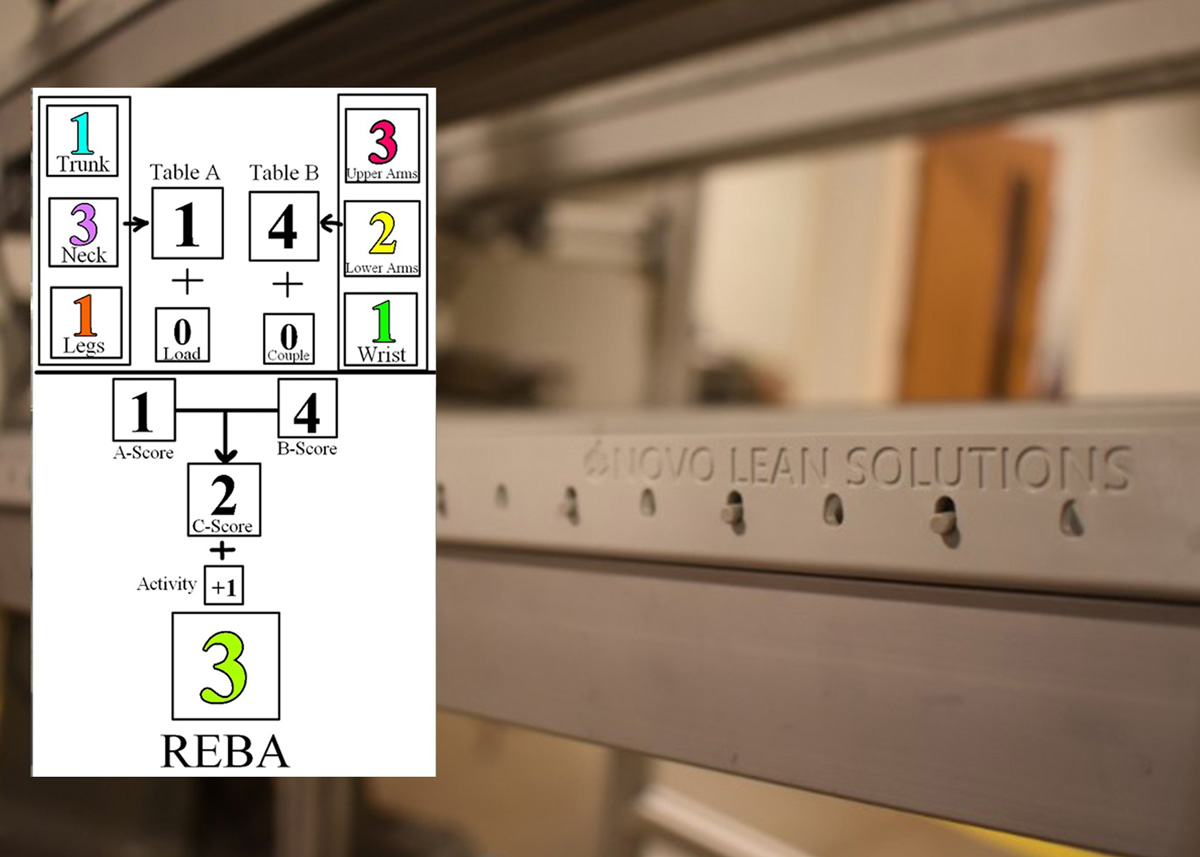
- REBA Score improved from 7 (Medium‑High Risk) to 3 (Low Risk) (See Figure 5)
- 100% of locations accessed >5x/minute fall within the “Green Zone,” described as two circles of 19.9” radius offset from one another by 13.19”.
- Operators reported reduced shoulder, arm, and back strain
- Material presentation improved cycle consistency
- Overreach was eliminated for all high‑frequency tasks
- Workstation adjustability enabled rapid changeovers and future Kaizen events
- Visual Management improved through standardized presentation zones

Figure 5: Operator Demonstration of Assembling Product on New Novo Lean Solution Team Member Workstation
The Team Member Workstation now serves as a core product in the Novo Lean Solutions catalog - engineered for safety, built for flexibility, and designed to evolve with the customer’s production needs.