
Signs Your Manufacturing Workstation Needs an Upgrade
A manufacturing workstation should do more than provide a place for an operator to work. It should support the process, reduce unnecessary movement, promote ergonomics, and seamlessly adapt as production needs shift.
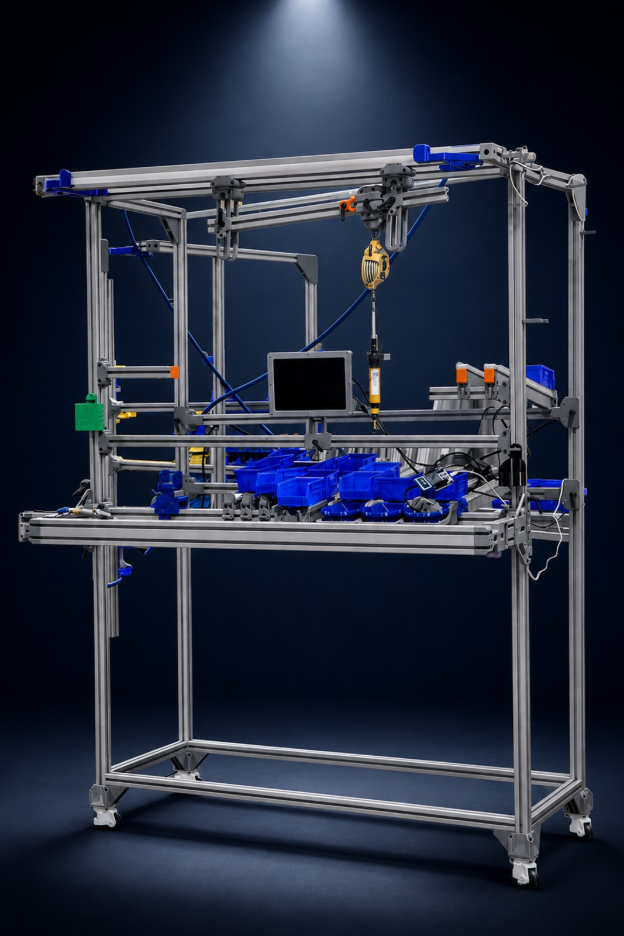
However, even a setup that once served your line well can turn into a bottleneck when customer demand fluctuates or product mixes change. Standard off-the-shelf industrial benches lack the agility to keep pace with these shifts.
Here are five signs your workstation layout is holding back your line, and how superior modular flexibility changes the game.
1. Waste in Process with Reaching, Bending, or Walking
One of the clearest signs of an inefficient workstation is unnecessary operator movement.
If employees regularly have to reach across a large work surface, bend down to retrieve materials, turn away from their primary work area, or walk to another location to get tools and parts, your workstation layout may be creating unnecessary motion. With that comes unnecessary time wasted.
A well-designed workstation places frequently used tools, components, and materials within easy reach, allowing operators to move naturally. Operators can spend more time adding value and less time searching, walking, or repositioning.
Ergonomic workstation layouts help reduce unnecessary movement while creating a more comfortable and efficient working environment.
2. Your Workstation Doesn't Match Your Current Process
Manufacturing processes don't stay the same forever.
You may have added a new product, changed an assembly process, introduced new equipment, or adjusted your material flow. But if your workstation still reflects the way the process worked years ago, it could be holding your operation back.
A workstation should evolve with the process, not force the process to work around the workstation.
Modular systems, such as those built with T-slot aluminum extrusion, make it possible to reposition accessories, add components, expand the structure, or reconfigure the layout as production requirements change.
This flexibility can be especially valuable during Kaizen events and continuous improvement initiatives, when teams are constantly looking for ways to improve workflow.

3. Tools and Materials Are Difficult to Find
When operators have to search for tools, parts, or supplies, small delays can quickly add up.
A tight, cluttered workstation can also make it harder to identify missing materials, maintain consistent processes, and keep the work area organized.
Accessories such as tool hangers, tool boards, parts trays, storage cubbies, bin rails, tote supports, shelves, and label holders can help create a more organized point-of-use workspace.
The goal isn't simply to make a workstation look cleaner. It's to make the correct tool or material available exactly where and when it's needed.
4. Your Material Flow Is Creating Extra Work
Material presentation can have a significant impact on workstation efficiency.
If operators have to walk to a separate storage area, dig through containers, or manually move materials into position before they can begin working, your material flow may need improvement.
Gravity FIFO flow lanes can help present materials at the point of use while supporting First-In, First-Out inventory management. As materials are removed, gravity helps move the next container into position.
This can reduce unnecessary movement while making inventory easier to see and replenish.
A well-designed workstation considers not only where the operator works, but also how materials arrive, move through, and leave the work area.
5. Your Workstation Can't Keep Up With Continuous Improvement
Perhaps the biggest warning sign is when making an improvement to your process requires replacing the entire workstation.
Lean manufacturing is built around continuous improvement. As teams identify problems and test new ideas, the physical work environment needs to be able to change with them.
A modular workstation gives manufacturers the flexibility to make those changes without starting from scratch.
Novo Lean Solutions uses structural T-slot aluminum extrusion to create customizable workstations that can be modified, expanded, and reconfigured as production needs evolve. Key-slot mounting allows accessories to be installed, removed, or repositioned quickly, helping teams adapt their workstations as processes improve.
A modern workstation should also support the operational technologies used to improve production. From production and quality tracking to Andon systems, real-time Safety-Quality-Delivery-Cost-Morale metrics, video for problem-solving and training, and camera-based quality verification and SPC tracking, your workstation needs to integrate with the systems your operation relies on.
What Should You Look for in a New Workstation?
If you've identified several of these issues, upgrading doesn't necessarily mean replacing everything with a completely new system.
Start by looking at the process.
Observe the operator. Identify unnecessary movement. Look at where materials are stored and how they reach the workstation. Determine which tools are used most frequently. Then consider how the workstation could be adjusted to better support the actual workflow.
The best workstation isn't necessarily the biggest or most complex. It's the one designed around the work being performed.
Outperform Fixed Equipment with Novo Lean Solutions
Standard, rigid workbenches force your processes into a box. Novo Lean Solutions designs custom industrial workstations built specifically to conquer dynamic demand and evolving shop floors.
Built with heavy-duty structural T-slot aluminum extrusion and quick-adjust key-slot mountings, Novo workstations provide unmatched agility over standard market alternatives. Whether you are rebalancing assembly lines, reconfiguring testing cells, or optimizing packaging stations, our systems give you the ultimate edge in flexibility.
Is your workstation adapting to customer demand...or holding your shop floor back?
Contact Novo Lean Solutions today to build a workstation that moves at the speed of your business.
